
Know what changes for your users
when you ship.
UXSense helps you investigate real user behavior after releases and brings that evidence into future change decisions.
You shipped. How did users react?
For each release, it:
- 01Compares real user behavior before and after changes.
- 02Detects meaningful behavior shifts and UX issues.
- 03Highlights where friction increased or decreased.
- 04Explains the likely impact in plain language.
As soon as there have been enough sessions (~30) you get a concise, actionable Release Impact Report. And your very first report is a UX Health Audit: what's already broken and creating friction for users, before you ship anything.
No guesswork. No replay rabbit holes. No waiting weeks to be sure.
v2.14.3·Checkout Flow Redesign
Checkout completion rate dropped 8.2% for returning users. New “express checkout” button is being missed on step 3. New users appear unaffected — they have no prior muscle memory.
- HighStep 3 abandonment rate+340%
- MedTime on step 3+2.4s
- PosNew user completion rate+12%

Drift
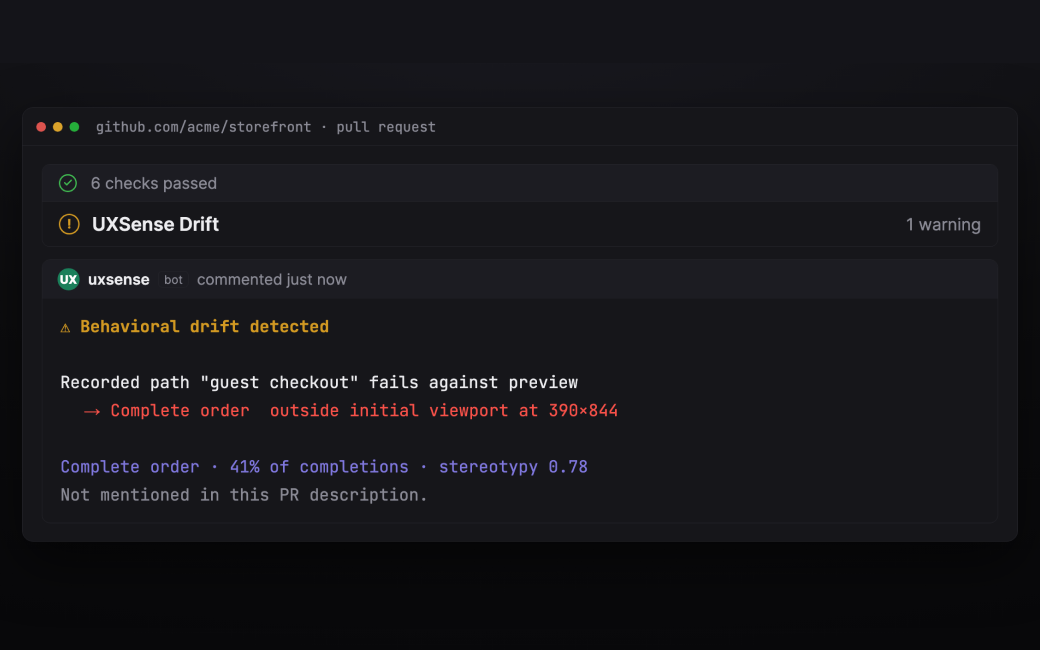
Your agents can't see your users. Drift checks every PR against what they actually do.

Releases
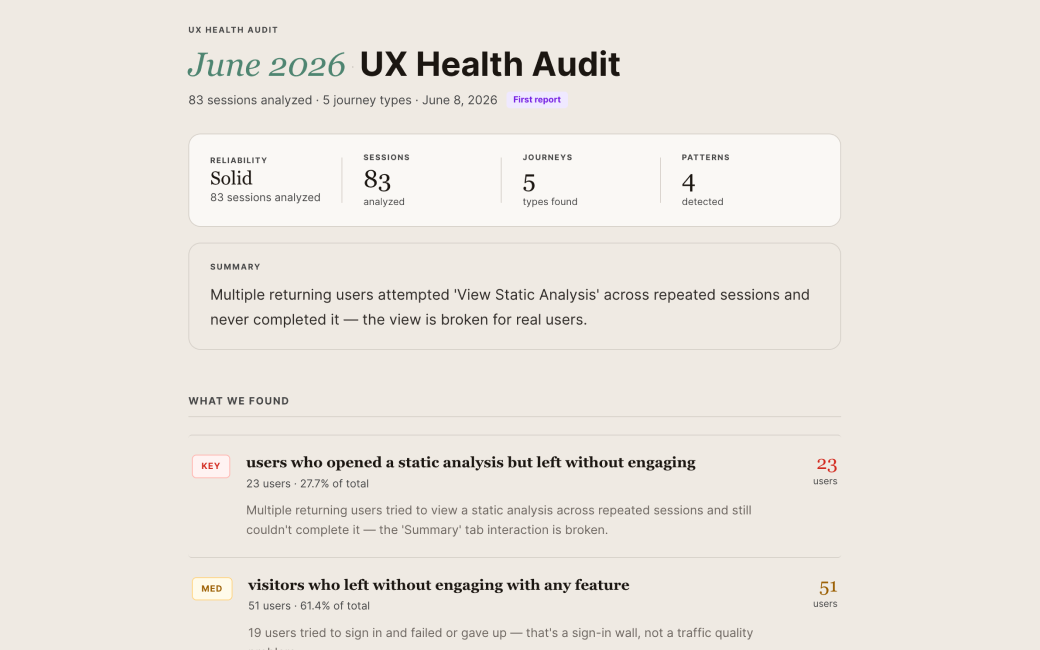
What every deploy did to real user behavior. What broke, what improved, what to fix first.
Calibrated together.
Combined, every Drift prediction is graded against the release that Release Reports measures. Any signal that doesn't predict reality is removed automatically.
Most teams don't realize when they break the UX.
Not because they're careless, but because the signals are subtle. After a release:
- Users hesitate where they didn't before.
- Flows take longer to complete.
- Power users stumble in familiar places.
- Support questions rise without a clear cause.
By the time the issue is obvious, the damage is already done.
Every UI change affects user behavior, even small ones.
Those changes show up as:
The evidence already exists in your session data. What's missing is an automated way to compare before vs after and clearly answer:
“Did this release change how users behave, and does it matter?”
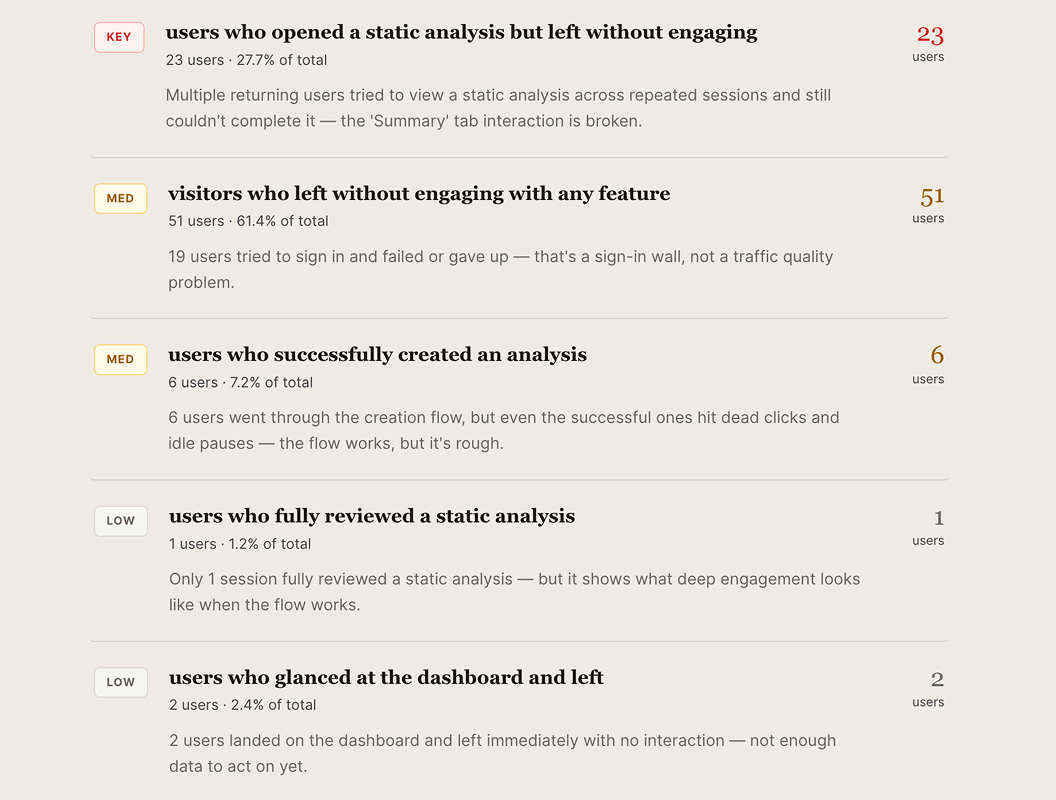
This isn't another dashboard. It's your behavioral check, every time you ship.
Before UXSense
- UX issues surface days or weeks later. By the time you notice, thousands of users have already been affected.
- Investigation is manual and anecdotal. Someone has to dig through analytics, screenshots, and Slack threads.
- Teams debate whether a problem is “real.” Without clear data, conversations stall and fixes get deprioritized.
- Insights live in dashboards no one checks. The data might exist, but no one's watching it after every release.
With UXSense
- Behavior changes surface within 24 hours. You see what shifted, not weeks later.
- Every change is tied to a specific release. No more guessing which deploy caused the drop.
- Statistical evidence replaces gut feel. Before/after comparisons, with every figure computed from your sessions, never generated by an AI.
- The verdict comes to you. A short digest lands in Slack after every release, the full report is there when you want to dig in.
You don't have to wait for your next release.
UXSense reads the session data you already have — PostHog, your existing replay tool, whatever you're running — finds your recent releases with enough traffic on both sides, and measures them. What broke, what improved, what to fix first. On releases you shipped weeks ago.
No instrumentation. No waiting for traffic. No new dashboard.
Runs in your project directory. Finds the session data you already have and hands the setup to your coding agent.
If your recent releases were clean, it says so. A quiet result is still an answer.
Setup takes minutes, not weeks.
Compares thousands of sessions to detect meaningful behavior changes between release windows.
Works alongside your existing product analytics stack.
Add one line to your site.
The lightweight UXSense snippet records sessions directly, no session replay vendor required. Already recording? No problem, connect your existing replay tool and the load map starts building.
Compares behavior before and after each release.
AI analyzes thousands of sessions to detect meaningful user behavior changes between release windows.
Delivers a Release Impact Report automatically.
A concise, actionable summary explaining what changed, who was affected, and whether it matters.
Your agents can't see your users.
AI agents now write most of the code that lands in your repo. They satisfy every observable objective: tests pass, types check, spec met, and they have no idea that the button they just moved carries most of your checkout completions, or that your returning users reach for it from muscle memory.
Pairs with your code reviewer.
A CodeRabbit-style review asks “is the code good?” UXSense Drift asks the question no reviewer can: “does this change break what users actually do?” Both are valuable and they never overlap.
UXSense builds a Behavioral Load Map from your recorded sessions and checks every pull request against it:
- BlocksA real recorded user path fails against your preview — the check blocks (overridably; sometimes breaking the path is the point) path_broken
- WarnHigh-completion-share element removed or renamed high_load_modified
- AdvisoryMuscle-memory surface reordered stereotypy_risk
- AdvisoryUnclaimed surface — the diff touches loaded surface the PR description never mentions. The signature failure of agent-authored code: intent described accurately, side effects not at all unclaimed_surface
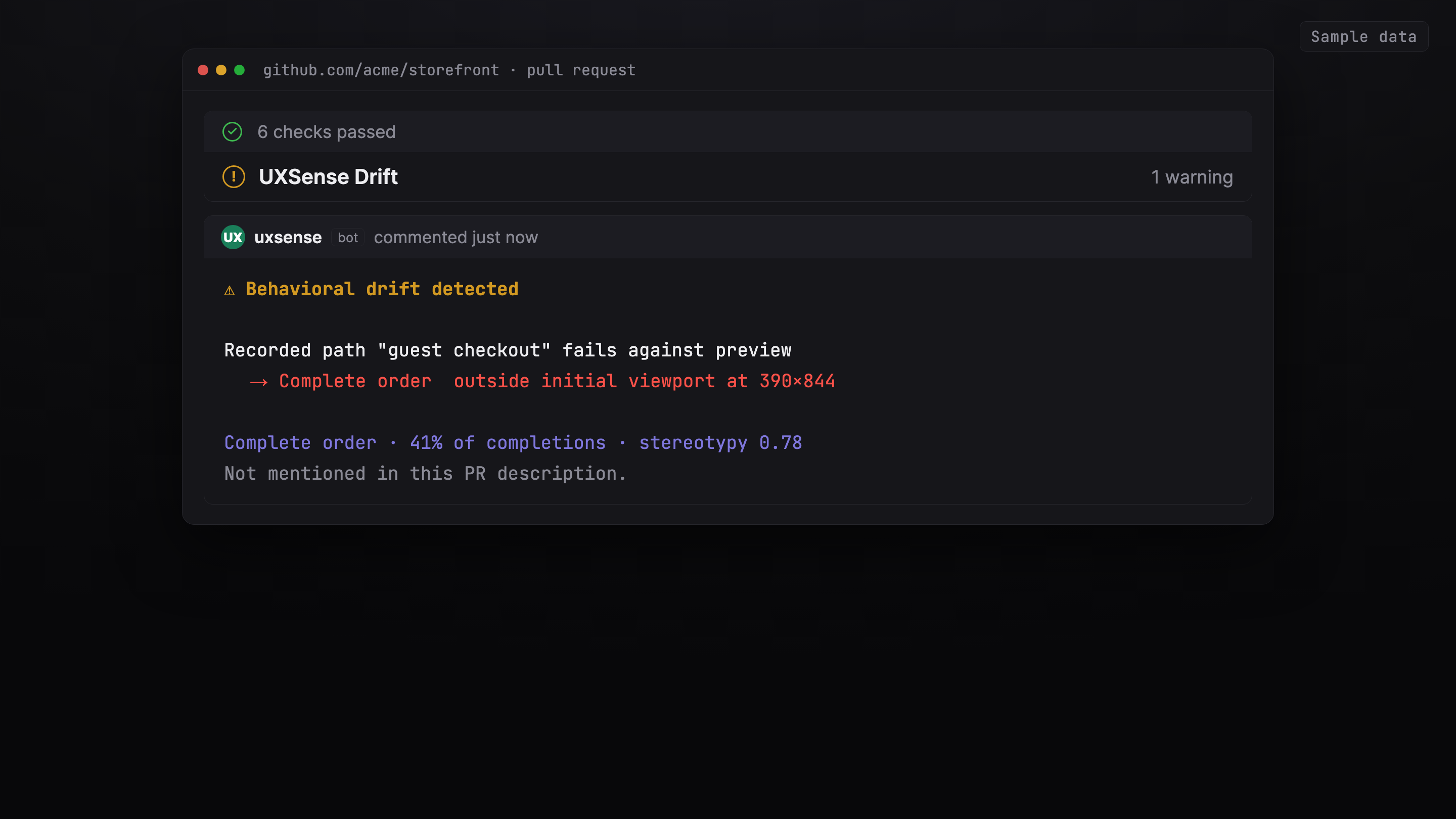
Agents consume the check and self-correct before a human ever opens the PR.
How Drift works →BEHAVIOR.md a spec written by your users.
Specs go stale the day they're written. BEHAVIOR.md doesn't, because your users write it. One command generates a markdown file from recorded sessions, the elements that carry behavioral load, the muscle-memory surface, the paths that must keep working, and you commit it to your repo where every coding agent reads it before editing.
No one maintains it. It regenerates on its own, based on actual user behavior.
Agent context files describe your app. This one weighs it.
Coding agents are learning to read the repo before they edit. Those files are attested — something looked at the app and wrote down what it found. BEHAVIOR.md says which of those names carries most of your completions — measured from sessions your users actually ran.
Drift reads both. Keep a .sightmap/ corpus and Drift names the exact surface a pull request touches, instead of describing it.
Attested context tells an agent what exists. Measured context tells it what matters.
Works with Sightmap. If your repo has a .sightmap/ corpus, Drift uses it — real component names in every check, and element identity that survives refactors without a build step.
Specs are aspirational. Your session corpus is reality.
Spec checkers ask
- “Does this PR match what we wrote down?”Written specs are aspirational, they drift from reality and no one keeps them current.
- No measured outcomes, no calibration. A drift checker without measured outcomes can never calibrate; it can only opine.
UXSense asks
- “Does this PR break what users actually do?”Your session corpus can't drift: it is reality.
- Every prediction gets graded. Because UXSense measures every release's real impact, every PR-time prediction gets graded against what actually happened, signals that don't predict real behavior change get demoted or removed.
UXSense is for teams who:
Ship UI changes regularly
Weekly, daily, or hourly, every release deserves a check.
Care deeply about UX quality
Anecdotes aren't enough. You want evidence.
Don't want another tool to babysit
One snippet, zero dashboards, the verdict comes to you.
Want fast, evidence-backed answers
After shipping. Not weeks later.
It's not built for teams shipping rarely, or relying only on top-line metrics.
Easy to try, easy to grow with.
Drift checks pull requests before merge. Releases tells you what actually happened after you shipped.
Drift Free
Free for up to 3 seats. Unmetered checks, unlimited repos. Not a trial.
- Unmetered PR checks
- Behavioral Load Map + BEHAVIOR.md
- Load, stereotypy, and unclaimed-surface signals
- 30-day session retention
- Sampled above 5,000 sessions/mo
Drift Team
A seat is a teammate whose pull request got a Drift check this period. Seats add themselves, nothing to assign. Bots and coding agents are never billed.
- Everything in Free
- Path replay against preview deploys
- Vercel / Render preview integration
- Build-time stamping plugin
- 90-day retention · unsampled to 50,000 sessions/mo
Releases
Post-deploy Release Impact Reports — what actually happened after you shipped, investigated and explained.
- First Report1 report lifetime · no card$0
- Starter5 reports/mo · 1 project$59/mo
- Team7 reports/project/mo · 3 projects$119/mo
- GrowthUnmetered reports · unlimited projects$219/mo
- EnterpriseSSO · SLAs · account managementCustom
Annual on any paid tier: 10× monthly — 2 months free.
First report freeBoth products, one price.
Combine Drift Team + Releases Growth for one flat fee, includes up to 6, 20, or 50 checked seats. At 20 seats ($449/mo) Release reports are practically free.
Annual: 10× monthly, 2 months free
Anyone can build a PR checker. Only a system that measures real behavioral outcomes can calibrate one.
Your first report is free.
Every new account starts on Drift Free and a free first report, no credit card required. You see what UXSense finds in your own product before you pay anything.
No contract, cancel anytime.